
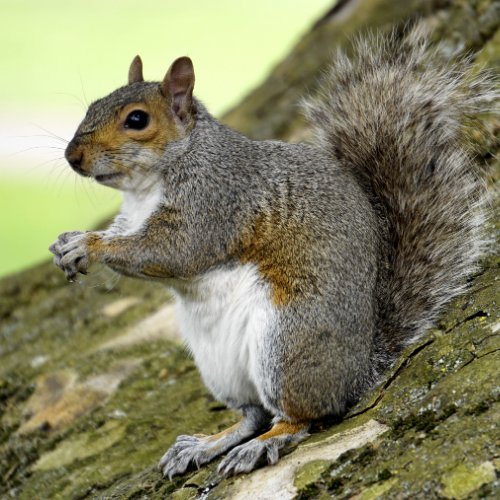
Squirrels are the wildlife call we get most in the northern half of Mercer County, and it isn’t close. Princeton, Pennington, Hopewell Borough, Hopewell Township and Hightstown share two things that squirrels love: big old trees that reach right to the roofline, and big old houses with a lot of roofline to reach. Put those together and every fall a certain number of attics along Nassau Street, Main Street and Broad Street become squirrel nurseries. This is what that means for the house, how to know it’s happening, and what actually stops it.
The problem isn’t the squirrel. It’s the teeth.
A squirrel’s front teeth never stop growing, so a squirrel never stops chewing. Outside, that’s bark and nuts. Inside an attic, it’s rafters, insulation, the plastic on ductwork and, worst of all, wiring. Chewed wiring in an attic is one of the ways house fires start, and it’s the reason we treat squirrels as a real problem rather than a cute one. Add the nesting material they drag in, the droppings that accumulate near the entry, and the smell of a squirrel that got stuck in a wall cavity, and a “harmless” squirrel becomes an expensive one.
Timing matters too. Squirrels in this part of New Jersey have two breeding seasons, late winter and midsummer, so a single squirrel that moved in during November is a litter by March. The scratching gets louder, the chewing gets worse, and the removal gets more complicated.
How to know it’s squirrels and not something else
Squirrels keep daytime hours. If you’re hearing scurrying, scratching or a rolling sound overhead around sunrise and again in the late afternoon, that’s the squirrel schedule. Raccoons are nocturnal and heavier, with slow thumps after dark. Mice are a constant faint scratching at night inside the walls rather than across the ceiling. Bats are almost silent, with fluttering at dusk near a vent.
Outside, look for a chewed opening at the roofline with fresh wood showing, a gable vent with bent or missing louvers, or a spot where the fascia meets the roof deck and the gap has been worked open. Squirrels leave a gnawed edge that raccoons don’t. And look up: if there’s a limb within eight or ten feet of the roof, that’s the highway they’re using.
Why the old houses get it worst
Princeton’s Western Section, the streets around Nassau Street, Hopewell Borough’s Broad Street, Pennington’s Main Street and the Stockton Street historic district in Hightstown are full of houses built between the 1850s and the 1920s. They’re beautiful, and from a squirrel’s perspective they’re full of doors. Original wood fascia and soffits that have softened in places. Dormers whose side walls meet the roof at a joint that has opened over a century. Slate and cedar roofs with lifted edges. Gable vents that were never screened because nobody screened gable vents in 1890. Porch roofs that tie into the main house at a seam. Every one of those is an entry point for an animal that only needs a gap the size of a golf ball.
And the trees are older than the houses. The sycamores and oaks that make these streets what they are also put a branch within jumping distance of nearly every roof. A squirrel doesn’t need to climb your siding; it walks down a limb and steps onto the gutter.
What we do, in order
Our squirrel removal work follows the same sequence every time, because doing it out of order is how squirrels come back.
Inspect the whole roofline. Not the one spot where you heard the noise. A squirrel that’s been in an attic has almost always opened more than one way in and out, and on an older house we regularly find three or four. We look at every foot of fascia and soffit, every vent, every dormer and porch joint, and the chimney, from the ground with a good light and from the roof where it’s safe.
Get them out humanely. One-way doors over the active entry let squirrels leave to feed and not get back in. Where there’s a nest with young, we time the work so the mother can move them, because sealing babies inside is cruel and it also means dead animals in your walls. Trapping is a backup, not a first move, and we follow New Jersey’s rules on handling and relocation.
Seal everything. Once the attic is empty, every opening gets closed with materials a squirrel can’t chew through: galvanized hardware cloth, metal flashing, fitted vent covers, a proper chimney cap. Foam and caulk are a snack. This is wildlife exclusion, and on a historic house we do it so it doesn’t show; the goal is a sealed roofline, not a patched one.
Clean up. Nesting material, droppings and soiled insulation come out, because scent is what draws the next squirrel and the mice that follow. If the insulation is too far gone we’ll say so.
What you can do about the trees
Trimming branches back so nothing is within eight to ten feet of the roof is the single most effective thing a homeowner in Princeton or Hopewell can do, and on a historic street it’s also the one people resist most. We understand; those trees are the point. But a limb touching the roof is an open invitation, and it’s also the route squirrels use to test the roofline again after we’ve sealed it. A good arborist can usually clear the roof without changing how the tree looks from the street. Bird feeders within a few feet of the house are the other big draw; move them out into the yard for the winter.
Squirrels rarely come alone
The same rooflines that let squirrels in let everything else in. In Hopewell Borough, the tall Victorians with open gable vents that get squirrels in the fall get bats in the summer. In Hopewell Township, with the Sourlands and Baldpate right behind the houses, a squirrel job often turns up raccoon sign as well. And in all of these towns, the mice arrive a few weeks after the squirrels open the door. That’s why we look at the whole house rather than the one problem you called about, and why we recommend our Comprehensive Rodent & Pest Defense Plan after a wildlife job: it includes rodent coverage, four seasonal visits and unlimited callbacks, so the sealed roofline stays sealed and someone is checking it.
A note on the neighbors
On the tighter streets in Princeton, Pennington and Hightstown, squirrels move between houses the way they move between trees. If your attic is sealed and the house next door isn’t, the squirrels don’t disappear; they relocate thirty feet. We’re happy to look at neighboring houses on the same visit, and more than a few of our jobs on these streets have turned into two or three houses getting done the same week, which is cheaper for everyone and actually solves the block.
If you’re hearing it now
Questions we get about this
How do I know if the squirrels have babies up there?
Timing is the first clue: late February through April and again July through September are the breeding windows around here. Sound is the second: young squirrels make a high chirping or crying that adults don’t. If you’re hearing that, don’t seal anything and don’t set a trap, because separating the mother from the nest is how you end up with dead animals in the wall. We’ll time the exclusion so she moves them.
Can I just put a radio in the attic or use a repellent?
Homeowners try it every year and it almost never works. Squirrels get used to noise and light quickly, and the repellent sprays and granules sold at hardware stores have no meaningful track record against an animal that has already decided your attic is home. The only thing that reliably ends it is removal followed by sealing the roofline with materials they can’t chew.
Will you damage the historic trim on my house?
No. On the older houses in Princeton, Pennington and Hopewell Borough we match flashing and screening to the existing details so the sealed roofline doesn’t read as patched. We’ll also tell you when the real fix is a carpenter replacing a rotted section of fascia, because sealing over rot doesn’t hold.
What does squirrel removal cost?
It depends on how many animals, how many openings and how much clean-up, so we quote after a free inspection. One squirrel and one entry in the fall is the cheapest version; a family, several openings and torn-up insulation in March is the most expensive. The estimate is written and we’ll tell you the least you need to do.
The sooner we look, the smaller the job: one animal and one opening in November, a family and several openings in March. Call 609-356-PEST (7378) or request a free inspection. We’re in Lawrence Township, a few minutes down Route 206 or Route 31 from Princeton, Pennington and Hopewell, and squirrel work is what we do most on that side of the county from October through April. Our full range of wildlife removal services is here if it turns out to be something else.