
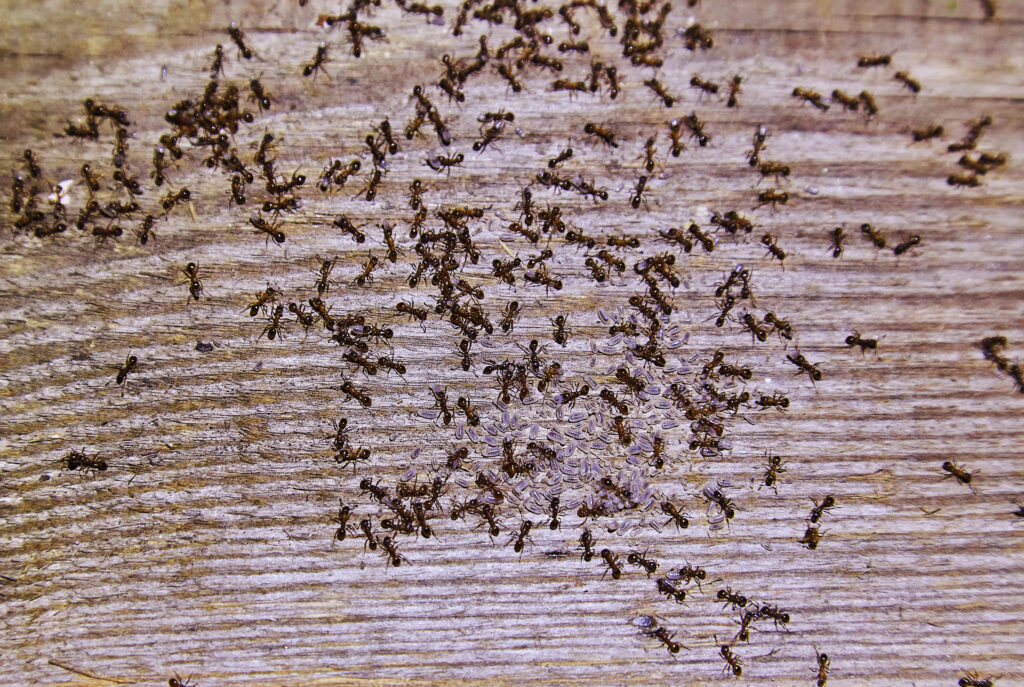
Cold weather has already set in, the yard is cold and quiet, and there’s a big black ant walking across your kitchen floor. Then another one shows up near the window. Most homeowners assume ants disappear when the cold sets in, so this one feels strange.
Finding carpenter ants in house in winter usually means the colony isn’t outside at all. In most cases, it’s nesting somewhere inside your home, in a warm, damp spot in the walls, floors, or roofline.
Why You’re Seeing Carpenter Ants in House in Winter
Carpenter ants are cold-blooded, so outdoor colonies go inactive once temperatures drop. When you see active carpenter ants indoors in winter, they’re almost always coming from a nest inside the house, usually in wood kept warm by your heating and softened by moisture from a leak, condensation, or poor ventilation.
The University of Minnesota Extension puts it plainly: seeing carpenter ants inside during winter means there is an indoor nest. That’s why a winter sighting deserves more attention than the same ant would in July, when it could easily have wandered in from the yard.
Outdoor Colonies Go Dormant, Indoor Ones Don’t
Outside, carpenter ants nest in stumps, dead limbs, firewood piles, and rotting fence posts. When a New Jersey or Pennsylvania winter sets in, those colonies slow down and wait for spring.
A colony inside your walls doesn’t get the same signal. Your home stays around 68 degrees, and a wall void near a heating duct, a bathroom, or a sunny south-facing window can stay warm enough for the ants to keep moving. On mild days, activity often picks up even more. So if you’re seeing carpenter ants in house in winter, the warmth they’re responding to is yours.
Main Colonies vs. Satellite Colonies
Carpenter ants often split their population between two kinds of nests:
- The main colony holds the queen, eggs, and young larvae. It needs steady moisture, so it’s often outdoors in a damp tree or stump, though it can sit inside a house with a long-running leak.
- Satellite colonies hold workers, older larvae, and pupae. They need less moisture and are the ones most often found inside homes, in wall voids, hollow doors, and insulation.
Workers travel between the two along regular trails. In winter, that travel stops outdoors, which is why indoor activity points to a nest inside the structure. A technician should confirm which kind of nest you’re dealing with, because it changes where treatment needs to go.
Signs of a Carpenter Ant Nest Inside Your Home
The ants themselves are often the first clue, but the nest usually leaves other evidence behind. These are the most common signs of carpenter ant nest activity we look for during a winter inspection:
- Frass: small piles of what looks like coarse sawdust, sometimes mixed with insect parts. Carpenter ants push it out of their tunnels, so it tends to collect along baseboards, under window sills, in basements near the sill plate, or below small slits in drywall or trim.
- Winged ants indoors in late winter: from late winter into spring, mature colonies produce winged ants that try to leave and start new nests. A large number of them inside, especially near windows, is a strong sign the colony is in the building. One or two on their own are less conclusive.
- Faint rustling in walls: in a quiet house, a large colony can make a soft crinkling or rustling sound inside a wall void or ceiling, often near a bathroom or kitchen.
- Ants trailing at night: carpenter ants are most active after dark. If you see them moving in a line along a baseboard, cabinet edge, or pipe late in the evening, they’re traveling a regular route to and from the nest.
You don’t need to see all four. Even one of these signs of carpenter ant nest activity, combined with winter ant sightings, is reason enough to have the home checked. Avoid cutting into walls to look; a technician can usually narrow down the spot without opening anything up. Tracking the colony this way is the first step in the work we do as an ant exterminator for homes across our service area: find the nest first, then treat where the ants actually live.
Where Carpenter Ants Nest in NJ and PA Homes
Carpenter ants follow moisture. Wood that stays damp gets soft, and soft wood is far easier for them to tunnel through. Much of the housing stock around Mercer County and Bucks County is older, with original framing, wood windows, and basements that see plenty of freeze-thaw cycles, so there are usually a few likely spots to check.
Window and Door Frames
Condensation and small gaps in caulking let water work into the wood around windows and exterior doors. The wall void just under a window sill is one of the most common indoor nest sites.
Sill Plates and Damp Basements
The sill plate is the wood board that sits on top of the foundation wall. In a basement or crawl space with high humidity or seasonal seepage, it can stay damp for months at a time, which makes it an easy place for a colony to settle.
Under Bathrooms and Dishwashers
A slow drip from a shower pan, toilet seal, or dishwasher line can soak the subfloor without anyone noticing. Small leaks under sinks are one of the most common reasons carpenter ants move indoors, and fixing them is one of the most effective things a homeowner can do.
Roof Leaks and Rooflines
Water from a worn flashing, a clogged gutter, or an ice dam can wet the rafters, fascia, and soffits. Ants nesting up there often show up in upstairs bedrooms or around a skylight or chimney.
If you already know about a leak in any of these areas, mention it when you call. It gives the technician a head start on finding the nest.
How Serious Is Carpenter Ant Damage?
Carpenter ant damage is real, but it’s usually slow. It’s not an emergency that will bring a wall down next week, and it’s also not something to ignore until summer.
The key difference from termites is that carpenter ants don’t eat wood. They chew it out to build smooth, clean tunnels called galleries, then push the shavings out as frass. Termites, by contrast, actually feed on the wood and pack their tunnels with mud and debris.
Because the ants are only hollowing out nesting space, the damage builds over time as the colony grows and adds satellite nests. A young colony may do very little harm. A colony that has lived in the same damp sill plate or window frame for several years can weaken that wood enough to need repair.
There’s also a second issue to keep in mind. Carpenter ants almost always point to a moisture problem, and that moisture can cause its own damage, from rot to mold, whether or not the ants stay. Treating the ants and fixing the water source together is what actually protects the house.
When to Call a Professional About Carpenter Ants
A few small steps are worth taking right away. Fix any leak you know about, run a dehumidifier in a damp basement, and move firewood stacked against the house to a spot several feet away. These help, but they won’t remove a colony that’s already living inside a wall.
That’s where store-bought sprays fall short too. They kill the ants you can see, while the nest, and the queen feeding it, stay out of reach. If you’re still spotting carpenter ants in house in winter after a week or two, it’s time to call.
What a Professional Visit Looks Like
Residential pest control for carpenter ants starts with finding the nest, not spraying the kitchen. During a visit, a technician will usually:
- Ask where and when you’ve seen the ants, and about any leaks or damp areas
- Inspect likely spots such as window frames, bathrooms, the sill plate, and the attic
- Follow trailing ants and look for frass to narrow down the nest location
- Apply carpenter ant treatment where the colony actually lives, and treat the exterior where ants could travel in from outside
- Point out the moisture source so you know what needs repair
We’ll also tell you honestly what you don’t need. If it turns out to be a few stray ants and not a nest, you’ll hear that from us.
Why Ongoing Coverage Works Best
A single carpenter ant treatment can knock down an active nest, but satellite colonies tend to come back to the same damp wood, and outdoor colonies wake up every spring. That’s why residential pest control for carpenter ants works best as ongoing coverage rather than a one-time visit.
Our Comprehensive plan covers carpenter ants, along with mice and stinging insects, starting from $65/month. It includes four seasonal visits, shed coverage, and a 100% satisfaction guarantee. The Essential plan, from $50/month, is a good fit for general exterior protection, but it doesn’t include carpenter ants.
Frequently Asked Questions
Do carpenter ants hibernate in winter?
Outdoor carpenter ant colonies go inactive during winter and wait for warmer weather, much like hibernation. Colonies nesting inside a heated home don’t always get that cue. The warmth from your house can keep them active through the cold months, which is why winter sightings usually point to a nest somewhere inside the structure rather than ants coming in from the yard.
If I see one carpenter ant in winter, do I have a nest?
Not always, but it’s worth paying attention. A single ant could have come in on firewood or a potted plant. If you keep seeing carpenter ants in house in winter over several days, or you notice frass or ants trailing at night, there’s a good chance a nest is inside. A technician can confirm it with an inspection.
Are carpenter ants the same as termites?
No. Carpenter ants have a pinched waist, bent antennae, and dark bodies, while termites have straight bodies and straight antennae. The bigger difference is behavior: termites eat wood, and carpenter ants only tunnel through it to nest. Both can damage a home, and both need professional treatment, but they’re handled differently, so correct identification matters.
How can I prevent carpenter ants from entering my home in cold months?
Focus on moisture and easy access. Fix leaks under sinks and around tubs, keep gutters clear, and run a dehumidifier in damp basements. Store firewood away from the house and bring in only what you’ll burn that day. Trim tree branches touching the roof, and seal gaps around pipes, windows, and utility lines. A recurring plan adds seasonal protection on top of these steps.
Stop Carpenter Ants Before Spring
Winter is actually a good time to deal with this. With nothing coming in from outside, indoor ants stand out, which makes them easier to trace back to the nest before April, when winged ants start swarming and outdoor colonies wake up. Taking care of carpenter ants in house in winter means fewer surprises once the weather warms.
If you’ve been seeing big black ants indoors this season, Fuessel Pest can take a look. We’re locally owned and operated, and we work with homeowners across Mercer, Middlesex, and Somerset counties in New Jersey and Central and Lower Bucks County in Pennsylvania. Call 609-356-PEST (609-356-7378) or reach out through our contact page, and we’ll find where the ants are coming from and tell you straight what it will take to stop them.