
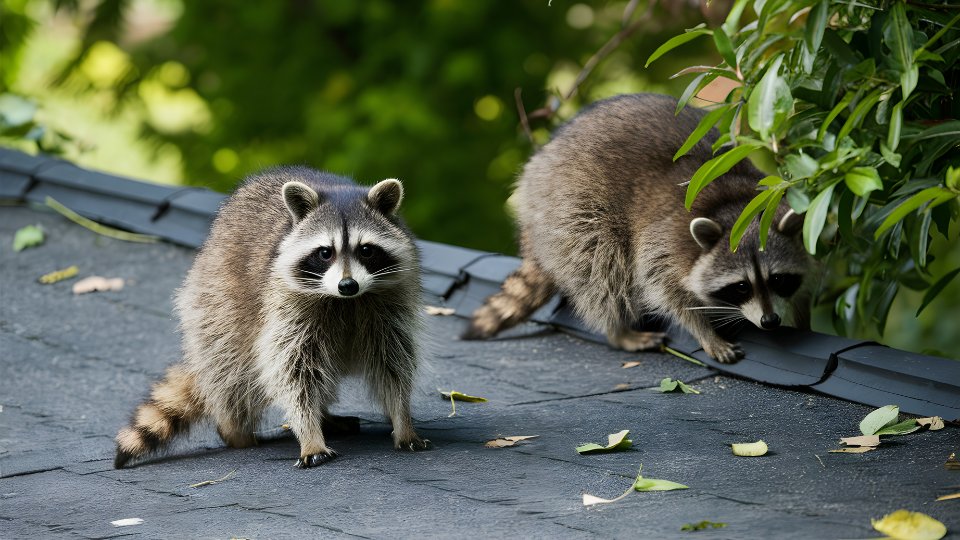
Every year around the first hard frost, the phones at our Lawrence Township office change. The ant and wasp calls stop, and the new ones all start the same way: “There’s something in the attic.” Sometimes it’s a heavy thump after dark, sometimes a scurry at dawn, sometimes just a smell nobody can place. Around Mercer County, that something is almost always a raccoon, a squirrel or a family of bats, and it moved in for the same reason you’d like to stay indoors in January: your attic is warm, dry and quiet.
Why winter is when wildlife moves in
Raccoons and squirrels don’t hibernate. They slow down, they need to conserve energy, and they look for a den that holds heat. A Central Jersey attic, insulated and sitting over a heated house, is the best den for miles. Squirrels start scouting in late fall and again in late winter ahead of their spring litters. Raccoons, especially females, are looking for a place to have kits by February or March, and an attic they found in December is where those kits will be born. Bats that didn’t migrate look for a stable, sheltered spot to overwinter, and gable vents and loose ridge caps are exactly that.
What makes Mercer County busy for us is the housing stock. The older colonials and Victorians in Princeton, Pennington, Hopewell Borough and the Trenton neighborhoods have decades of roofline: original soffits, gable vents that were never screened, and gaps where porch roofs and additions meet the main house. The mid-century neighborhoods in Hamilton, Ewing and Lawrence are all reaching the age where fascia boards soften and vent covers fail at the same time. And the wooded edges along the Sourlands, the D&R Canal and Mercer County Park mean the animals are already living a few hundred feet from the house.
How to tell what you’ve got
The timing and weight of the noise tells most of the story before we ever get on site. Squirrels are daytime animals, so scratching, rolling or light scurrying overhead around dawn and again at dusk is almost always squirrels. Raccoons are nocturnal and heavy, so slow, deliberate thumps or dragging sounds after dark, sometimes with chattering, point to a raccoon. Bats are quiet; what you notice is fluttering at dusk, dark staining around a vent or eave, and droppings collecting below the entry point. Mice are a constant faint scratching or gnawing inside walls and ceilings at night, and they usually show up a few weeks after the bigger animals opened the door.
If you’re still not sure, look outside on a cold morning. Tracks in frost or snow on the roof, a gap at the roofline with fur or grease marks around it, or insulation pulled out of a soffit are all confirmation.
Why waiting until spring costs more
Homeowners sometimes decide to ride it out and deal with it when the weather’s better. Here’s the problem with that. A squirrel in the attic spends the winter chewing, and wiring is one of its favorite things to chew. Raccoons use one corner of the attic as a latrine, and by March the insulation there is ruined and the smell has reached the bedroom below. A single female raccoon in December is a mother with four kits in March, which is a much harder removal and one that state rules limit during the birthing season. And every animal that spends the winter up there leaves scent behind that draws the next one.
Early in the season the job is usually one animal, one or two entry points and a light clean-up. Late in the season it’s a family, several openings, contaminated insulation and a bigger bill.
What we actually do
Our wildlife removal work in Mercer County follows the same three steps every time, because skipping any one of them is how the problem comes back.
Inspect the whole envelope. Not just the spot where you heard the noise. We walk the roofline, ridge and gable vents, soffit returns, chimney cap, plumbing and utility penetrations, and the skirting under decks and sheds. An animal that’s been in an attic has usually opened more than one way in.
Remove the animal humanely. One-way doors and exclusion devices where the species and season allow, humane trapping where they don’t, and we follow New Jersey and Pennsylvania wildlife rules on timing and relocation. For raccoons and squirrels that usually means the animal leaves on its own schedule and can’t get back in. For bats it means waiting for the right window so no animals are trapped inside.
Seal it and clean it. Every opening gets closed with hardware cloth, flashing or chew-resistant sealant, never foam. Then the nesting material, droppings and soiled insulation come out, because that’s what draws the next animal and the mice that follow. That last step, wildlife exclusion, is the part that makes it the last time you pay for this.
Then keep the mice out too
Raccoons and squirrels open the holes; mice use them next. That’s why we recommend putting the house on our Comprehensive Rodent & Pest Defense Plan after a winter wildlife job. It includes rodent coverage inside and out, four seasonal visits, and someone checking the sealed entry points before anything tests them again.
If you’re hearing something overhead anywhere in Mercer County, from Hopewell Township and Princeton down to Hamilton and Trenton, call us at 609-356-PEST (7378) or request a free inspection. The sooner we look, the smaller the job.