
There are two ways to handle a wildlife problem in a Mercer County home. One is to catch the animal. The other is to make the house impossible to get into. Most people call about the first and are surprised when we spend most of the visit talking about the second. That’s because after years of doing this from Trenton to Hopewell, we know which one actually ends the problem, and it isn’t the trap.
What exclusion means
Wildlife exclusion is the work of sealing every point on a building that an animal could use to get in, with materials that hold up to chewing, prying and weather, without interfering with how the building breathes and drains. It’s done either before anything has moved in, as prevention, or right after a removal, so the house that just had a raccoon doesn’t get the next one. It’s slower than setting a trap and it costs more up front. It is also the last time you pay for that problem, which is the whole argument.
Why trapping alone doesn’t work here
Trapping removes one animal. It does nothing about the reason that animal was there. In a county with the Sourlands, the D&R Canal, Mercer County Park, the Assunpink and dozens of smaller wooded corridors running right into the neighborhoods, there is always another raccoon, squirrel, skunk or groundhog a few hundred feet from the house, and it will find the same opening. Homeowners who go the trap-only route tend to become repeat customers of whoever sold them the trap, every fall, for years.
There’s a second problem. Animals leave scent, and scent is a signpost. A soffit that a squirrel used last winter smells like a squirrel den to the next squirrel. A chimney a raccoon used smells like a raccoon den. Unless the opening is closed and the area cleaned, the house is advertising.
The inspection is most of the job
Good exclusion starts with finding every opening, and animals rarely use the big obvious one. We walk the whole envelope of a Mercer County house in a specific order because that’s the order animals test it.
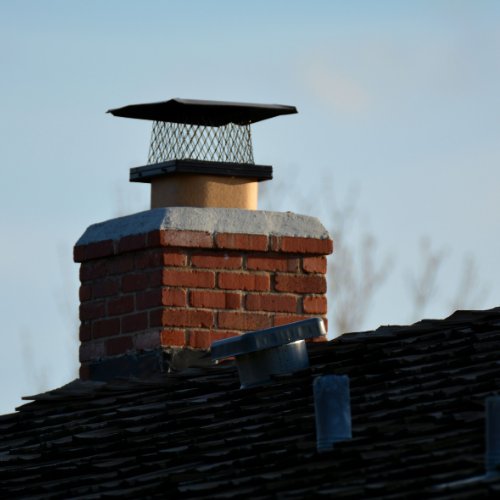
The roofline first: ridge vents, gable vents, soffit returns, the joints where roof planes meet, where dormers meet the roof, where porch roofs and additions tie into the main house. Then the chimney, its crown and its cap. Then every penetration through the walls: plumbing stacks, dryer and bath vents, the AC line set, gas, electric, cable. Then the foundation and grade: window wells, crawlspace vents, deteriorating mortar joints, the gap where a deck ledger meets the siding. Then under things: deck and porch skirting, the shed, the gap beneath the stoop. At each spot we’re reading the sign, claw marks, greasy rub marks, chewed edges, droppings, fur, because the sign tells us which animal has been testing that opening and how it needs to be closed.
Materials that actually hold
This is where most do-it-yourself exclusion fails. Expanding foam is a snack for a squirrel and a puzzle for a raccoon. Plastic vent covers snap off. Screening from the hardware store rusts through in a couple of winters. We use galvanized hardware cloth, metal flashing, chew-resistant sealants, properly fitted stainless or galvanized vent covers, and real chimney caps, installed so that vents still vent, gutters still drain and the attic still breathes. On the historic houses in Princeton, Pennington and Hopewell Borough we also do it so it doesn’t show; a sealed roofline shouldn’t look like a patched one.
Under decks, porches and sheds, the material goes down the skirting and then out, bent in an L below grade, so a skunk or groundhog that tries to dig under it hits mesh instead of dirt. That detail is the difference between exclusion that lasts and exclusion that lasts one season.
Never seal an animal in
This is the rule that separates exclusion from a patch job, and it’s the one homeowners break most. If an opening has fresh sign around it, something is using it, and closing it while the animal is inside means one of two outcomes: it dies in the wall, or it chews a new way out, and now you have two holes and a smell. Exclusion is done after removal, or with one-way doors installed over active entries so the animal leaves and can’t return. During the spring birthing season that timing matters even more, because a mother sealed out with young sealed in will tear the house apart trying to get back to them. We follow New Jersey’s wildlife rules on all of this, and we’ll tell you when the right answer is to wait a few weeks.
Clean-up is part of exclusion
Because scent is a signpost, the nesting material, droppings and soiled insulation come out as part of the job. That’s wildlife clean-up, and it’s also a health matter: raccoon latrines and bat guano carry things you don’t want in the air in your house. We remove contaminated material with proper protective equipment, deodorize, and tell you honestly whether the insulation needs replacing or can stay.
What exclusion looks like around the county
In Bordentown Township, where Crosswicks Creek and the Delaware wrap around Bossert Estates and Dunns Mill, exclusion is mostly about the roofline and the deck and shed skirting, because the creek corridors bring raccoons, skunks and groundhogs right into the yards. In Hopewell Township, with the Sourlands behind Titusville and Elm Ridge, it’s older farmhouses and outbuildings with a lot of openings and animals that have used them for years. In Robbinsville and West Windsor, newer construction usually means one or two vulnerable vents and a limb touching the roof. In Trenton’s rowhouse neighborhoods, it’s shared rooflines and uncapped chimneys, and the exclusion often needs to include the neighbor. And in Hamilton, Ewing and Lawrence, it’s the fascia and soffits on post-war houses that all reached the same age together.
Exclusion and mice
The gaps a raccoon or squirrel opens are the gaps mice use next, and mice need far less: a gap the width of a pencil is enough. A thorough exclusion job closes a lot of those too, but mice also use the small penetrations that wildlife ignores, which is why we pair exclusion with our Comprehensive Rodent & Pest Defense Plan. It includes rodent control inside and out, four seasonal visits, and someone checking the sealed entry points before anything tests them. Details are on the plans and pricing page.
When to do it
The best time is before the first freeze, when animals are scouting but haven’t moved in. The second-best time is right after a removal, while the attic is empty. The worst time is never, which is what most houses get. If you’ve had wildlife once, or you can see from the driveway that the fascia is soft and the gable vent has no screen, an exclusion inspection now is far cheaper than a raccoon in February. The inspection is free; the estimate is written; and we’ll tell you the least you need to do to actually close the house.
Questions we get about this
Is exclusion worth it if I’ve never had an animal in the house?
If you’re near woods, a creek or a park, or the house is more than about forty years old, yes. Exclusion done before anything moves in is the cheapest version of the job, and it’s a fraction of the cost of a raccoon removal plus a ruined attic. The inspection is free either way, and if the house is already tight we’ll say so.
How long does exclusion last?
The materials, galvanized hardware cloth, metal flashing and fitted caps, last for many years. What changes is the house: fascia softens, mortar weathers, a storm lifts a section of ridge vent. That’s why we pair exclusion with a plan that has someone walking the property every season, so a new gap gets caught before an animal finds it.
Does exclusion keep mice out too?
It closes the large and medium openings that wildlife uses, which are also the ones mice use most. Mice also fit through gaps far smaller than any raccoon needs, so a full rodent-proofing pass adds sealing at dozens of small penetrations. Our Comprehensive plan covers that side on an ongoing basis.
Do you do exclusion on commercial buildings?
Yes. Flat roofs with rooftop units, loading docks and dumpster corrals are where commercial buildings leak wildlife, and we handle exclusion for restaurants, property managers and warehouses across Mercer County as part of a scheduled commercial program.
Call 609-356-PEST (7378) or request a free inspection. We’re based on Franklin Corner Road in Lawrence Township and cover all of Mercer County, and exclusion is the part of wildlife removal we’d do first on our own homes.